
News Center
Your current location:Home > News CenterNews Center
Electrical lighting in a cleanroom
2026/7/1
1. Core Design Principles
1. Meet the illuminance and uniformity requirements
According to the "Design Standard for Clean Workshops" GB 50073, the illuminance requirements vary for different clean areas:
Clean operation area: ≥ 300 lx (such as pharmaceutical GMP workshops, electronic lithography rooms);
Auxiliary area (corridors, changing rooms): ≥ 200 lx;
The requirement for illuminance uniformity: ≥ 0.7, to avoid visual fatigue or operational errors caused by local light differences.
High cleanliness areas (such as Class 1 to 100 levels) need to avoid dust accumulation or particle generation from lighting fixtures, and prefer embedded or ceiling-mounted installation to reduce exposed components.
2. Meet the cleanliness level requirements
The lamp shell should use seamless, easy-to-clean materials (such as stainless steel 304, anodized aluminum), with a smooth surface without dead corners to prevent dust accumulation and microbial growth.
It is strictly prohibited to use lamps with glare or fragile materials (such as ordinary glass-covered fluorescent lamps), to avoid debris contaminating the clean environment.
The connection between the lamp and the ceiling needs to be sealed (such as using silicone sealing strips) to prevent particles from entering the clean area through gaps in the air flow.
3. Safety and explosion-proof regulations
For clean workshops with flammable or explosive gases or dust (such as chemical clean workshops, lithium battery material workshops), explosion-proof lighting fixtures should be selected and comply with the "Design Code for Electrical Installations in Explosive Hazardous Environments" GB 50058.
The protection level (IP) of the lamps should be ≥ IP54, waterproof and dustproof; in humid clean areas (such as biopharmaceutical workshops), it should be raised to IP65.
The electrical lines should be laid in conduits (such as galvanized steel pipes, PVC clean-specific pipes), with sealed pipe joints to prevent dust from entering the conduits.
4. Energy saving and intelligent control
LED energy-saving lamps should be preferred to replace traditional fluorescent lamps, which have advantages such as low power consumption, long lifespan (≥ 50,000 hours), no mercury pollution, and low heat generation, and can reduce the air conditioning load of the clean room.
Induction switches (human body induction, light sensing) or intelligent control systems can be configured to achieve off-light when no one is present, and zone dimming, reducing energy consumption.
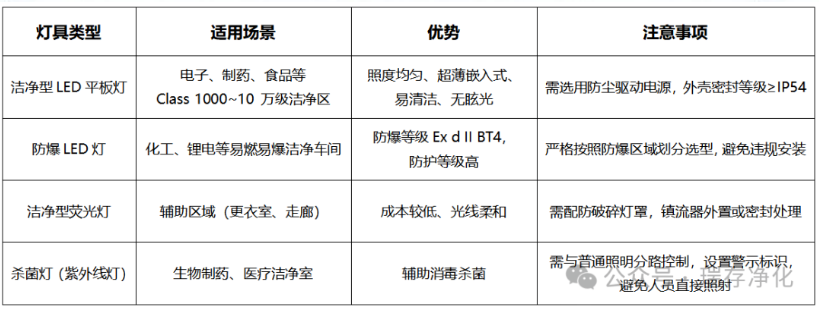
2. Common Lighting Fixture Selections
III. Installation and Construction Key Points
1. Installation Method
For the clean area lighting fixtures, embedded concealed installation is preferred, flush with the ceiling to reduce dust accumulation; when concealed installation is not possible, ceiling-mounted installation is used, and the base needs to be sealed.
The installation height of the lamps should be combined with the height of the clean room, generally 2.5-3m from the ground to ensure uniform illumination.
2. Wiring Requirements
Power cables should use flame-retardant, low-smoke, and halogen-free cables to avoid the generation of toxic gases in case of fire; when laid in conduits, the conduits need to be firmly fixed and the joints need to be sealed.
At the places where the lines pass through walls between the clean area and the non-clean area, fireproof sealant should be used to seal to prevent cross-contamination.
3. Grounding and Lightning Protection
All metal lamp housings need to be reliably grounded to prevent leakage;
The clean workshop needs to set up an independent lightning protection grounding system to avoid damage to electrical equipment due to lightning strikes.
IV. Maintenance and Management
Regularly clean the surface of the lamps, wipe with a dust-free cloth, and avoid using corrosive cleaning agents.
Regularly check whether the sealing strips of the lamps are aging, and replace them in time to prevent the deterioration of sealing performance.
Regularly inspect the drive power supply of LED lamps to avoid damage to the lamps due to power failure.