News Center
Your current location:Home > News CenterNews Center
Key features of the construction of high-level electronic cleanrooms
2026/1/16
1. Core objective: Nanometer-level pollution control
The core is to control "particles, molecular pollutants (AMC), static electricity, vibration", matching the requirements of 7nm and below chip manufacturing processes - a single particle could cause device failure. It is necessary to prevent material detachment, personnel / equipment bringing in pollution, and at the same time, control AMC such as acids, alkalis, and VOCs through chemical filtration to avoid damaging the photoresist and affecting accuracy.
2. Design and planning: Zones and air flow priority
Clean zones and pressure gradient: Different clean levels are divided according to the process (such as core area Class 4, auxiliary area Class 6), the positive pressure in the high-clean area is higher than that in the low-clean area (pressure difference ≥ 5 Pa), and airlock rooms / wind showers are set for isolation to prevent pollution from infiltrating. Layered laminar airflow organization: Adopt vertical unidirectional flow (laminar), clean air is supplied from the HEPA/ULPA covered layer under the ceiling, polluted air is discharged from the bottom of the floor / side walls, the wind speed is stable at 0.36-0.54 m/s, without vortex accumulation of dust. Movement separation: The movement lines of personnel (4-6 levels of changing rooms → wind showers → airlock), materials (coarse purification → fine purification → airlock), and processes (arranged in order of increasing pollution) are strictly separated to avoid cross-contamination.
3. Material selection: Low release, high cleanliness
All materials must be "without particle detachment, without AMC release, anti-static, corrosion-resistant, easy to clean", key materials are as follows:
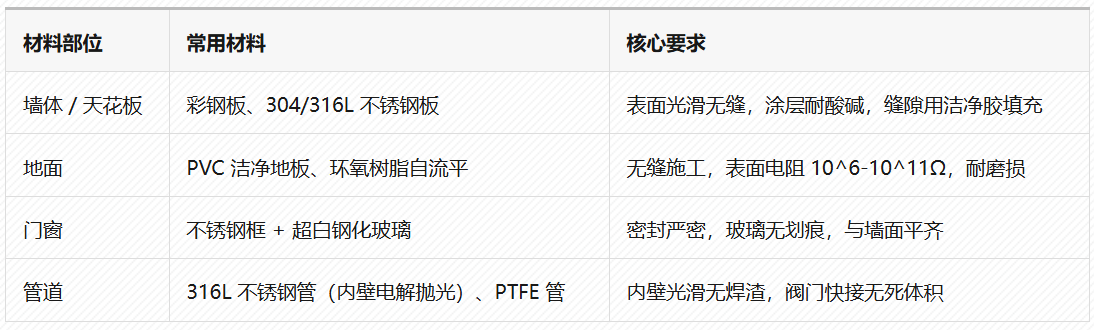
Material parts Common materials Core requirements
Wall / Ceiling Corrugated steel sheet, 304/316L stainless steel sheet Smooth surface without seams, coating resistant to acid and alkali, gaps filled with clean glue
Floor PVC clean floor, epoxy resin self-leveling Seamless construction, surface resistance 10^6 - 10^11 Ω, wear-resistant
Windows and doors Stainless steel frame + ultra-clear tempered glass Sealed tightly, glass without scratches, flush with the wall
Pipes 316L stainless steel pipe (inner wall electro-polished), PTFE pipe Inner wall smooth without welding slag, valves quick-connect without dead volume
VII. Construction process: Precise dust-free + Full monitoring
Clean construction environment: Build temporary clean sheds (Class 8) in stages, personnel wear temporary clean suits, tools are dusted, HEPA/ULPA installation is pre-cleaned for 12-24 hours and leak detection is conducted. High-precision construction: Ground flatness ≤ 2mm/2m, corrugated steel sheet joint ≤ 0.5mm, pipes are welded automatically with TIG, inner wall roughness Ra ≤ 0.8μm. Real-time monitoring: Measure particle count at construction nodes, measure laminar flow velocity at each point during ventilation debugging to ensure compliance.
VIII. System integration: High reliability, uninterrupted
HVAC system: Four-level filtration (primary → secondary → sub-primarily → HEPA/ULPA), temperature and humidity control accuracy ±0.1℃/±2% RH, key equipment is in one-to-one backup, switching ≤ 10 seconds. Pure water system: Multiple-stage purification (RO → EDI → ultrafiltration), outlet water resistivity ≥ 18.2MΩ・cm, full pipe transportation + circulation of pipelines. Gas system: Gas purification to 7N level, 316L stainless steel pipe + VCR joint, helium leak detection ≤ 1×10^-9 Pa・m³/s. ESD protection: Personnel wear anti-static wristbands/shoes, equipment grounding resistance ≤ 1Ω, real-time monitoring of static voltage ≤ 100V.
IX. Acceptance and operation: Compliance + Full cycle management
Acceptance: Comply with ISO 14644, SEMI S2/S8, etc. standards, test cleanliness, airflow, AMC, pressure difference, etc. Operation: Replace filters regularly (HEPA 1-2 years, ULPA 2-3 years), monitor environmental data daily, clean and train personnel regularly. In summary, this type of factory is a combination of "engineering precision + materials + environmental control + system integration", with unit cost ranging from 1.5 to 30,000 yuan /㎡, which is 5 to 10 times that of ordinary factories.