
News Center
Your current location:Home > News CenterNews Center
Operation and management of the HVAC system
2026/1/16
The core of the operation and management of the HVAC system is "demand-based adjustment and monitoring alerts". The goal of operation management is to achieve the optimal energy consumption while meeting the thermal comfort and air quality requirements of the building, avoiding "overheating" or "insufficient operation". Different strategies should be formulated based on the type of system (such as central air conditioning, wall-mounted heating, fresh air system, etc.). The key points are as follows:
1. Basic operation principles: Matching load, dynamic adjustment
The HVAC load (cooling and heating requirements, fresh air requirements) of the building will change dynamically with outdoor temperature and humidity, as well as indoor people density and usage scenarios (such as office / shopping center / residential). During operation, it is necessary to avoid "fixed parameter operation" and follow the "load matching" principle:
Central air conditioning system:
Summer cooling: When the outdoor temperature is <28℃ and there is no obvious heat sensation indoors, the compressor can be turned off and only the fan can be turned on for ventilation; the indoor temperature setting is recommended to be no less than 26℃ (national standard recommendation, each 1℃ increase can save 6%-8% energy).
Winter heating: When the outdoor temperature is above 5℃ and there is no obvious feeling of cold indoors, the supply water temperature can be reduced (for example, the supply water temperature for floor heating can be lowered from 50℃ to 40℃); the indoor temperature setting should not exceed 20℃ (each 1℃ reduction can save about 10% of energy). Fan coil units / air conditioning units: Switch the "high / medium / low" air speed according to the room usage (such as setting "low speed" or turning off for rooms without occupants).
Heating system (such as wall-mounted heaters, centralized heating):
Central heating: Adjust the supply water/return water temperature according to the outdoor temperature (for example, 60℃ when the outdoor temperature is -5℃, and 45℃ when the outdoor temperature is 5℃). Avoid "large temperature difference with small flow rate" or "small temperature difference with large flow rate" (which can easily lead to energy waste).
Wall-mounted heating system: Residential users can adopt "time-based and zone-based" control (for example, setting the temperature at 20℃ in the living room and 16℃ in the bedrooms during the day, and 20℃ in the bedrooms and 16℃ in the living room at night), and set to "frost prevention mode" (around 5℃) when no one is present.
Fresh air / Exhaust air system:
High-density areas (such as meeting rooms, shopping malls): Adjust the fresh air volume according to the number of people (national standard requires a minimum of 30m³/h of fresh air per person). Avoid "insufficient fresh air volume leading to excessive CO₂ levels" or "excessive fresh air volume resulting in energy waste".
Idle periods (such as during the night in an office building): Shut down the main fresh air fan and only turn on the exhaust fan to maintain a slight negative pressure inside the room (to prevent outdoor pollutants from entering).
2. Key Parameter Monitoring: Real-time System Status Monitoring
It is necessary to regularly monitor the core parameters of the system to promptly identify "abnormal operations" (such as blockages, leaks, equipment failures):
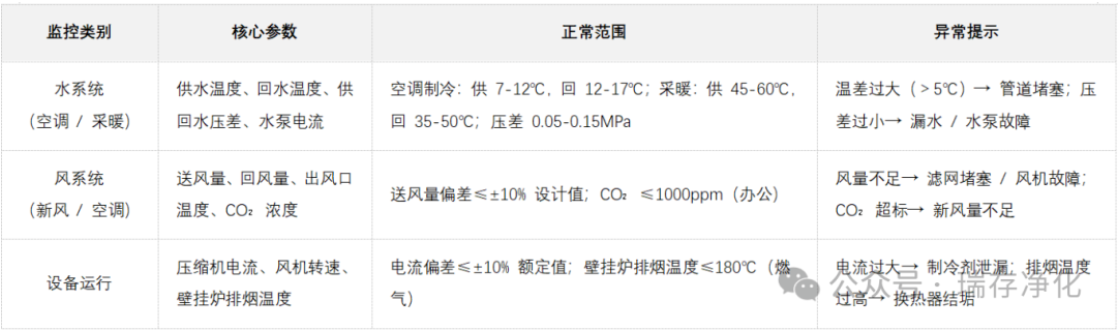
The operation of the HVAC system is a "system engineering" project. The core logic is: adjust and monitor as needed during operation; through scientific management, the service life of the HVAC system can be extended by 5-10 years, energy consumption can be reduced by 15%-30%, while ensuring a comfortable environment and air quality within the building.